Can You Safely Epilate Your Bikini Area?
Epilation for bikini area grooming is usually safest when you treat it as bikini-line maintenance, not a rushed full pubic-hair removal session. Start on the outer edge, keep the skin stretched flat, and stop if the device catches or pinches instead of pushing through.
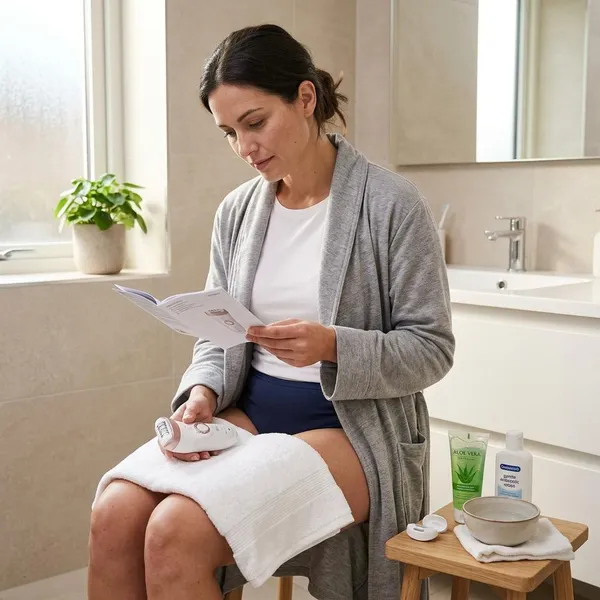
Can you safely epilate the bikini area
You can epilate the bikini area safely in many cases, but the safest answer is narrower than many people expect: the outer bikini line is the best place to begin. Inner, softer, or folded areas are more likely to pinch and are not worth forcing if your device, pain tolerance, or visibility is not right.
Before you start, check three things first: your skin is healthy, your epilator is suitable for sensitive areas, and you can clearly stretch the area you want to treat. Skip epilation if the skin is broken, sunburned, inflamed, infected, or reacting to another product.
Start with the outer bikini line
The outer bikini line is easier to see, easier to hold taut, and usually less sensitive than the inner pubic area. If your goal is simply to keep hair from showing around underwear or a swimsuit, this may be the only area you need to epilate.
A first-time user should treat the first session like a patch test: clear a small strip, then wait and see how the skin looks the next day. Someone who already epilates their legs may still need to go much slower here because bikini hair is often coarser and the skin moves more.
Use only approved attachments
Use the sensitive-area cap, bikini attachment, or skin-contact cap only if your epilator manufacturer says it is suitable for that area. These attachments can limit how much skin reaches the tweezers and make the head easier to control around curves.
- Good sign: the cap fits firmly and is listed for bikini or sensitive areas.
- Bad sign: the attachment wobbles, exposes too much tweezer area, or comes from an unrelated model.
- Safer alternative: trim or shave sections that feel too soft, painful, or hard to stretch.
Follow your epilator manual
Your manual matters more here than it does on larger areas like the legs. Check whether your model can be used wet, which speed is recommended, which head is approved for bikini-line use, and how the head should be cleaned afterward.
If the manual does not mention bikini or sensitive-area use, be cautious. That does not always mean the device is unusable, but it does mean you should avoid inner areas and start with the smallest possible outer-line test.
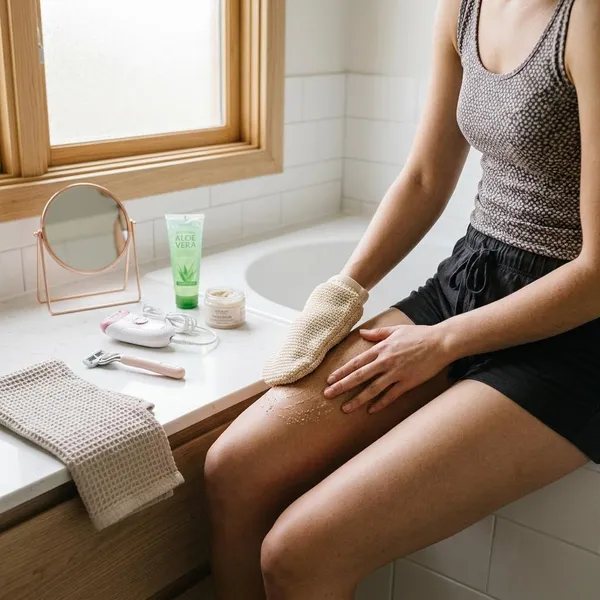
How to prepare for bikini area epilation
Good preparation reduces tugging, repeated passes, and unnecessary irritation. The priority is not a complicated routine; it is getting the hair to a workable length, keeping the skin clean, and setting yourself up so you can move slowly.
If you are epilating before a beach day, holiday, or event, do not make your first attempt the same morning. Try it at least a day or two earlier so any redness has time to settle and you can see how your skin responds.
Trim longer hair
Trim longer hair before epilating so the device can grip without dragging. Many epilators work best when hair is short but visible, often around a few millimeters long; if your manual gives a length range, follow that first.
Do not shave immediately before epilating. Hair that is too short may not be caught well, which leads to extra passes and more irritation without much result.
Exfoliate the day before
Gentle exfoliation the day before can help remove surface buildup that may trap regrowth later. A soft washcloth or a mild product you already tolerate is enough; this is not the place for harsh scrubbing.
Clean and warm the skin
A warm shower before epilation can soften the area and remove sweat, oil, and lotion. If your epilator is dry-use only, dry the skin fully afterward so the tweezers can catch hair cleanly.
Avoid applying heavy creams or oils before the session. They may make the skin slippery and can reduce grip, which often makes people press harder than they should.
Choose wet or dry epilation
Wet epilation may feel gentler for sensitive skin if your model is designed for it. Dry epilation usually gives better visibility and makes it easier to check hair direction, which can be useful along the bikini line.
Set up good lighting
Use bright, direct light and a mirror if needed. Poor lighting is one of the easiest ways to miss hairs, repeat the same patch too often, or move into an area you cannot stretch safely.
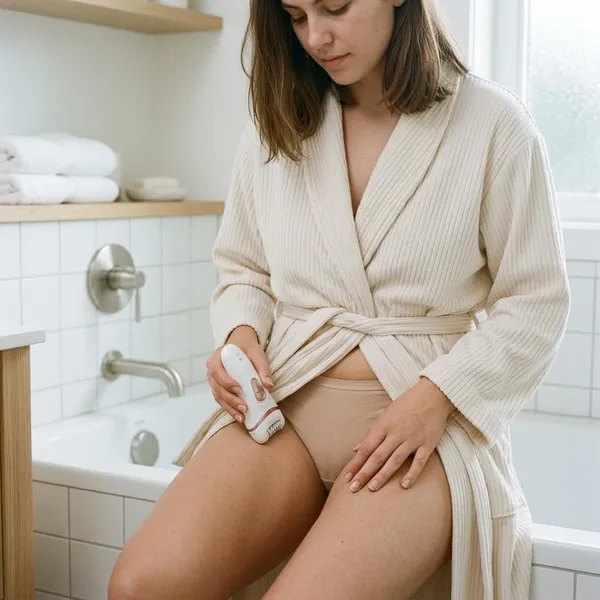
How to epilate the bikini area
The safest technique is slow, small, and controlled. Work from the outer edge inward only as far as you can keep the skin flat, and do not aim for a perfect result during your first session.
Start on the outer edge
Begin at the outermost visible part of the bikini line and make one short pass. If the skin only looks mildly pink and the hair is coming out cleanly, continue in nearby sections instead of jumping to a more sensitive area.
Pull the skin taut
Skin tension is the most important safety habit during bikini epilation. Use your free hand to stretch the skin flat before the epilator touches it, and change position if you cannot keep that tension comfortably.
If you are working near a curve or fold and cannot make the surface flat, leave that area alone or use a trimmer. Forcing the epilator over loose skin is when pinching becomes much more likely.
Hold the epilator at 90 degrees
Hold the epilator at about 90 degrees to the skin unless your manual gives different instructions. Let the head rest lightly on the surface rather than tilting it flat or digging it in.
Move slowly against hair growth
Move slowly against the direction of hair growth where your device instructions support it. Bikini hair can grow in mixed directions, so check each small section instead of assuming one upward or sideways pass will work everywhere.
- Too fast: more missed hairs and more repeat passes.
- Too many passes: more redness without much extra smoothness.
- Better approach: one slow pass, then reassess before repeating.
Use light pressure
Light pressure is enough. If the epilator is not removing hair well, check hair length, angle, direction, and skin tension before pressing harder.
Heavy pressure usually adds friction rather than effectiveness. In a sensitive area, that can turn a manageable session into soreness that lasts longer than it needed to.
Stop if the skin pinches
Turn the epilator off immediately if the skin pinches. Do not pull the device away while it is still running.
After a pinch, reset your grip and return to an easier outer section only if the skin looks calm. If you feel tense, shaky, or unable to see clearly, ending the session is the better choice.
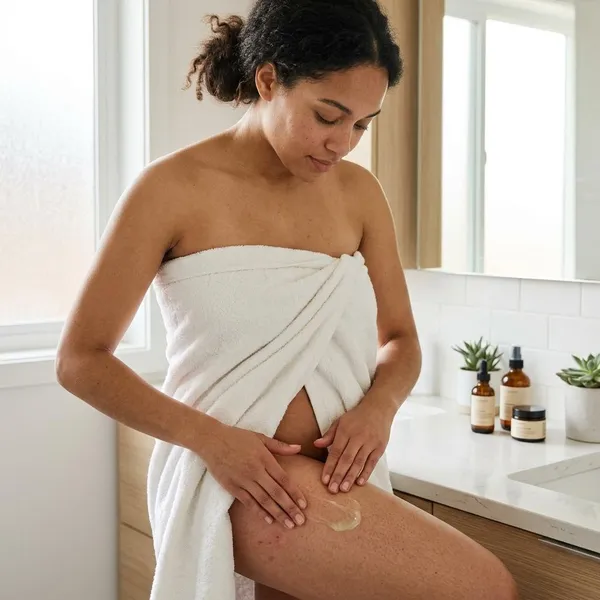
How to care for skin after epilation
Aftercare should calm the area, not overload it. Right after epilation, the follicles and skin surface may be more reactive, so simple choices usually work better than strong products or extra grooming.
The first day matters most. If you keep heat, sweat, rubbing, fragrance, and harsh exfoliation away from the area, you lower the chance of turning normal redness into bumps or stinging.
Apply a gentle moisturizer
Use a light, fragrance-free moisturizer, plain aloe vera gel, or another bland soothing product you already know your skin tolerates. Avoid alcohol-heavy formulas, essential oils, and strong active ingredients right after epilation.
Avoid heat and friction
Skip hot baths, saunas, steam rooms, and hard workouts for the rest of the day if possible. Heat and sweat can make the area feel more inflamed, especially if your skin tends to get red a few hours after hair removal rather than immediately.
If you have to exercise or commute in warm weather, choose breathable clothing and shower gently afterward. Summer bikini-line maintenance often needs more friction control than winter grooming because sweat and tight swimwear can irritate the area quickly.
Wear loose clothing
Loose underwear and relaxed clothing give the treated follicles room to settle. Tight leggings, shapewear, stiff seams, and synthetic fabric rubbing directly on the bikini line can make small bumps more likely.
Exfoliate after the skin settles
Wait until redness and tenderness are gone before exfoliating again. For many people, that means waiting a couple of days, then using a gentle washcloth or mild exfoliant once or twice a week if the skin tolerates it.
Do not scrub bumps aggressively. If a hair seems trapped, gentle maintenance is safer than digging, picking, or repeatedly exfoliating the same spot.
Clean the epilator after use
Clean the epilator head after every session according to the manual. Brush out hair and rinse only parts that are designed to be rinsed; a cleaner head performs better and is less likely to bring old debris back onto freshly treated skin.
How often to epilate the bikini area
Most people do better when they wait for both conditions: the skin has fully settled and the hair is visible enough for the epilator to catch. A fixed calendar schedule is less useful than checking those two signs.
Allow redness to settle
Do not epilate again while the area still looks inflamed, feels sore, or itches in a way that seems more than mild recovery. If your skin needs longer than expected after the first attempt, stretch out the next session rather than trying to train it with more irritation.
Wait for visible regrowth
Wait until you can clearly see or feel regrowth. That gives the tweezers something to grip and lets you check the direction of growth before you start.
This is especially useful if your bikini hair grows unevenly. Some patches may be ready before others, and it is fine to tidy only the areas that have enough regrowth.
Epilate shorter regrowth
Once you know your skin tolerates epilation, shorter regrowth is usually easier to manage than long, overdue growth. Maintenance sessions can be quicker and less intense, but the area may never become completely painless.
For occasional grooming before swimwear, leave extra time for redness to settle. For year-round maintenance, a lighter routine with shorter sessions is often more comfortable than waiting weeks and trying to clear everything at once.
Conclusion
Bikini area epilation is most sensible when you keep it limited, controlled, and honest about your skin's reaction. If you can stretch the outer bikini line clearly, use the right attachment, and stop at the first sign of pinching, it can be a useful longer-lasting option; if the area is irritated, hard to see, or too painful to control, trimming or shaving is the better choice that day.
FAQS
Does bikini epilation hurt less over time?
Often, yes. Shorter maintenance regrowth and better technique can make sessions feel more predictable, although the bikini line may still be sensitive compared with legs or arms.
Can epilation make bikini hair grow back thicker?
No. Epilation removes hair from the root, but it does not make the follicle produce thicker hair; uneven regrowth can simply make the area look different for a while.
When should irritation after epilation be checked?
Get advice from a pharmacist, doctor, or dermatologist if redness worsens, lasts more than a few days, or comes with swelling, pus, increasing warmth, or strong pain. Mild pinkness soon after epilation is common, but signs of infection are not something to wait out.

Popular Articles