How Long Does Facial Laser Hair Removal Last on the Face?
Facial laser hair removal usually lasts months to years after a full course, but it is better to think of it as long-term reduction rather than permanent smoothness. The first thing to check is whether your facial hair is dark and coarse enough for laser, because fine, pale, gray, or hormonally driven hair is less predictable. If treatment works well, regrowth is usually slower, finer, and easier to manage, with touch-ups planned around your own pattern.
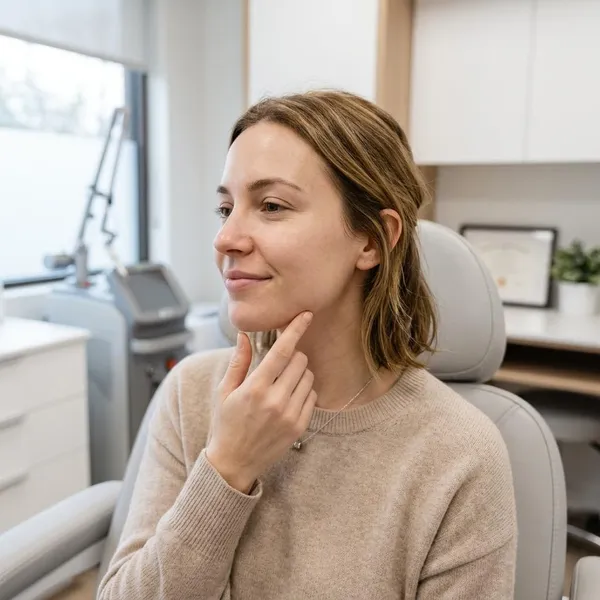
How long does facial laser hair removal last?
For many people, facial laser results last from several months to a few years after the initial course. Some stay mostly clear for a long time, while others notice chin, upper lip, or jawline regrowth sooner. The face is more hormone-sensitive than areas such as the legs, so it is one of the places where maintenance is most common.
| What you notice | What it usually means |
|---|---|
| Hair grows back finer and slower | The follicles may have been weakened, even if not fully disabled. |
| Only a few dark hairs return | A targeted touch-up may be enough. |
| Many new coarse hairs appear | Hormones or new growth may be involved, especially on the chin or neck. |
| Remaining hairs are blonde, gray, red, or very fine | Laser may not be the best next step; electrolysis may be worth discussing. |
What changes during a treatment course?
Facial laser changes the growth pattern gradually. One session does not catch every follicle, because hairs move through different growth stages. A full course gives the laser repeated chances to target hairs when they are actively growing.
During the course, judge progress by pattern rather than by one bad week. You want to see fewer coarse hairs, slower regrowth, and longer gaps between the times you feel the need to shave or trim.
Shedding after each session
Shedding is expected after treatment and may look like the hair is still growing. Treated hairs can work their way out of the skin over the next couple of weeks, which often creates tiny dark dots or short stubble. That does not automatically mean the session failed.
Less regrowth between appointments
The clearest everyday sign of progress is needing less maintenance between visits. Someone treating a small upper lip area may notice this earlier; someone treating hormonally active chin or jawline hair may need more patience because regrowth can be uneven.
- Good sign: hairs return slower than before.
- Good sign: coarse patches become thinner or more scattered.
- Worth asking about: the same dense growth returns quickly after several sessions.
- Do not judge too early: one or two sessions rarely show the final pattern.
Remaining hair after the initial course
Some remaining facial hair after the first course is normal. The key question is whether those hairs are still good laser targets. A few dark chin hairs may justify a touch-up, while scattered pale or very fine hairs may be better handled another way.
Why facial hair can return after laser
Facial hair can return because some follicles were not in the right growth stage, some were only weakened, and some hairs may be new growth rather than old growth coming back. These causes are not the same, so they should not be treated the same way.
The most important distinction is between normal mild regrowth and a change in your overall hair pattern. A few softer hairs months later is common. A sudden increase in dark, coarse hair across the chin, neck, or jawline deserves a more careful conversation, especially if it comes with other hormonal changes.
Follicles missed during earlier growth cycles
Laser works best when a hair is actively growing. At any appointment, some facial follicles are resting or not producing a strong target, so they can be missed even when the treatment is done properly. This is the reason a course of sessions is planned instead of a single visit.
Partial follicle damage
A follicle does not have to be completely disabled for the treatment to be useful. Sometimes it is damaged enough that the hair grows back thinner, softer, or much slower. For everyday life, that can be the difference between constant stubble and occasional cleanup.
Partial damage also explains why one extra session may help some returning dark hairs, but not every leftover hair deserves more laser. If a hair has become very fine or light, repeating the same treatment may bring little benefit.
Hormonal changes and new hair growth
Hormonal shifts can activate new facial hairs after an otherwise successful course. This can happen with conditions such as PCOS, around menopause, with some medications, or with other health changes that affect androgen levels. A laser clinic can treat suitable hairs, but it cannot stop the body from producing new hormone-driven growth.
- Lower-concern scenario: a few soft hairs return slowly after many clear months.
- More cautious scenario: new coarse hairs appear quickly in several facial areas.
- Practical next step: track the change and ask whether a medical or hormonal review makes sense.

If heavier growth appears suddenly, do not assume more laser is automatically the answer. It may still help with dark coarse hairs, but the underlying trigger may need attention too.
How to plan facial laser maintenance
Plan maintenance around what actually grows back, not around a fixed promise from a clinic. After the initial course, give the area time to settle, then look at the amount, texture, color, and location of regrowth. That gives you a better plan than booking repeat sessions just because the calendar says so.
Track regrowth after the initial course
Take simple photos every few weeks in similar lighting, especially before shaving. Memory is unreliable when facial hair feels emotionally frustrating; photos make it easier to see whether the hair is truly returning heavily or just feels noticeable because it is on the face.
- Note the area: upper lip, chin, jawline, neck, or sideburns.
- Note the texture: coarse, soft, fine, or downy.
- Note the timing: weeks, months, or longer after the last session.
- Note sudden changes: faster or heavier growth than before.
Review suitable hairs with your provider
Before paying for maintenance, ask your provider to separate hairs that are worth lasering from hairs that are not. Dark coarse hairs are the usual candidates. Pale, gray, red, blonde, or very fine hairs often need a different plan.
This check is especially useful if your face now has mixed hair types. You may only need laser on a few darker chin hairs and electrolysis for isolated lighter ones. Treating the whole area again can be unnecessary if only one small zone is active.
Schedule touch-ups around your response
Touch-ups make the most sense when the returning hair is visible enough to bother you and suitable enough for laser to work. If you remain mostly clear for a year, there is usually no reason to rush back. If coarse chin hairs return after a few months, a targeted appointment may be more sensible than waiting until the whole area feels difficult again.
- Wait for a clear pattern. Do not judge the result while shedding or irritation is still settling.
- Treat only active zones. The upper lip and chin may not need the same schedule.
- Change methods when needed. Laser is not always the best tool for sparse fine leftovers.

Conclusion
Facial laser hair removal can be a very useful way to reduce dark, coarse facial hair for the long term, but it is not a guarantee that the area will stay completely smooth forever. The smartest approach is to judge the result by how much easier the hair is to manage, then use touch-ups only when the returning hairs are suitable for laser and noticeable enough to be worth treating.
FAQS
Does shaving between sessions affect lasting results?
No. Shaving does not usually reduce lasting results because it cuts the hair at the surface and leaves the follicle in place for the next treatment. Avoid waxing, tweezing, or plucking unless your provider tells you otherwise.
Will stopping maintenance undo previous results?
No. Stopping maintenance does not reverse follicle damage already achieved. You may see gradual regrowth or new hormone-driven hairs, but that is different from losing all previous progress.
Is heavier facial hair growth after laser normal?
It is not the usual result. If hair seems darker, thicker, or more widespread after treatment, ask your provider about possible causes, including hormonal changes or the rare risk of paradoxical hair growth.


Popular Articles