Which Facial Laser Works Best for Dark Skin?
Facial laser hair removal can be a good option for dark skin, but only when the laser choice, settings, and provider experience are right for melanin-rich skin. The first thing to check is not the price or package size; it is whether the clinic regularly treats darker facial skin with an appropriate laser and is willing to patch test when needed.
Is Facial Laser Hair Removal Safe for Dark Skin?
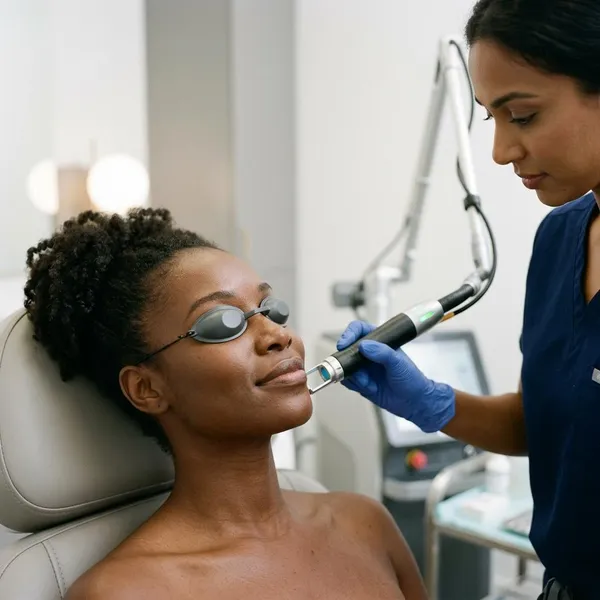
Yes, it can be safe, but dark facial skin needs a more careful plan than lighter skin or less visible body areas. The main concern is that melanin in the skin can absorb heat as well as the hair follicle, especially if the wrong device or aggressive settings are used.
Before booking, the consultation should answer three practical questions:
- What laser will be used? Ask for the device type and wavelength, not just the word "laser."
- How often does the provider treat darker facial skin? Experience with legs or underarms is not the same as treating the upper lip, chin, or jawline.
- Will they adjust for your skin history? Recent tanning, post-inflammatory hyperpigmentation, acne products, peels, and certain medications can all change the risk level.
A patch test is often worth requesting for the face, especially if you scar easily, get dark marks after irritation, or have never had laser before. For someone with coarse chin hair and no recent irritation, treatment may be straightforward. For someone using retinoids, shaving daily, and dealing with fresh dark marks, waiting and calming the skin first may be the safer move.
Which Lasers Suit Dark Skin?
The safest choice usually comes down to how selectively the device can target the hair while avoiding excess heat in the surface skin. True lasers use a specific wavelength; IPL uses broad-spectrum light. That difference matters more on dark skin because scattered or less selective light can increase the chance of burns and pigment changes.
Hair type also changes the decision. Coarse, dark chin hair gives the laser a stronger target. Soft cheek fuzz gives it very little to work with and may not be worth the risk.

Long-pulsed Nd:YAG at 1064 nm
Long-pulsed Nd:YAG at 1064 nm is commonly preferred for deeper skin tones because it penetrates more deeply and is less absorbed by surface melanin than shorter wavelengths. That makes it a strong first option to ask about if you have Fitzpatrick IV to VI skin.
It is especially useful for dark, coarse facial hair on the chin and jawline. The trade-off is that results are gradual, sessions can still feel uncomfortable, and safe settings may be conservative rather than maximally aggressive.
Diode lasers with individualized assessment
Diode lasers may suit some darker skin tones, but this should never be treated as an automatic yes. The provider needs to consider your exact skin depth, hair thickness, cooling method, pulse settings, and history of pigmentation.
A diode may be reasonable for medium-deep skin with dense, dark facial hair. If your skin is very deep, highly reactive, or prone to light or dark marks, Nd:YAG may be the more cautious choice. A clinic should be able to explain why it is choosing one over the other.
Why IPL is a different treatment
IPL is not the same as laser hair removal. It uses broad-spectrum light rather than one focused wavelength, which makes it less precise on melanin-rich skin.
That does not mean every IPL treatment causes harm, but the face is not a good place to gamble with vague "laser-like" marketing. If a clinic offers IPL for dark facial skin, ask exactly why they believe it is appropriate and what they will do if your skin reacts badly. Home IPL devices deserve even more caution because they do not come with clinical judgment or individualized settings.
Which Facial Hairs Respond Best?
Laser works best when the hair is dark enough and thick enough to absorb energy. That is why two people with the same skin tone can have very different outcomes: one may get a useful reduction in chin hair, while another sees little change in fine cheek fuzz.
| Facial hair type | Laser suitability | Better next step |
|---|---|---|
| Dark, coarse chin or jawline hair | Usually the strongest candidate | Ask about Nd:YAG and realistic maintenance |
| Fine peach fuzz | Unpredictable and sometimes not advised | Discuss non-laser options before treating |
| Grey, white, blonde, or very light hair | Poor laser target | Consider electrolysis |
Risks to Discuss Before Treatment
The main risks for dark facial skin are burns, blistering, dark or light pigment changes, scarring, and paradoxical hair growth. These risks are not a reason to rule out treatment automatically, but they are a reason to avoid rushed appointments and vague promises.

Burns and blistering
Burns and blistering are more likely when the wrong device is used, settings are too high, cooling is poor, or the operator is inexperienced with dark skin. Severe pain, sudden greying or whitening of the skin, rawness, or blisters are warning signs that should not be ignored.
If this happens, seek medical advice promptly rather than trying to treat it with harsh home remedies. A responsible provider should stop treatment when the skin reacts badly, not push through the session.
Dark or light pigment changes
Hyperpigmentation means darker marks develop after inflammation. Hypopigmentation means treated skin becomes lighter than the surrounding area. Both can be upsetting on the face, even when they are not permanent.
The practical prevention step is to keep inflammation low: conservative settings, good cooling, no treatment over irritated skin, and careful sun protection afterward. If you often get dark marks after acne, waxing, or shaving, say that clearly during the consultation.
Scarring
Scarring is uncommon, but it is possible after deeper burns or poorly managed blistering. Mention any history of keloids or raised scars before treatment because it may change how cautious the provider needs to be.
Paradoxical hair growth
Paradoxical hair growth means the treated or nearby area develops thicker-looking hair instead of less hair. It is more relevant on the face than on many body areas, especially when the original hair is fine or borderline for laser.
This is where saying no to treatment can be the better decision. Coarse chin hair may be worth treating; soft cheek fuzz often deserves a much more conservative discussion.
Conclusion
The safest path is to treat facial laser hair removal on dark skin as a selective treatment, not a one-size-fits-all beauty service. If you have dark, coarse chin or jawline hair and access to an experienced provider using an appropriate laser, it can be genuinely helpful; if the hair is fine, light, or the clinic cannot explain its device and safety plan, waiting or choosing another method is the smarter call.
FAQS
Can laser help with facial razor bumps?
Yes. By reducing coarse regrowth, laser may lower the number of hairs that curl back into the skin and trigger bumps.
Can laser treat PCOS-related facial hair?
Yes, but it usually means reduction and maintenance rather than a permanent cure. If growth is changing quickly, it is worth discussing the hormonal side with a medical professional too.
How many facial sessions will I need?
Many people need a series of sessions, often several months of treatment, because facial hair grows in cycles. Hormonal chin or jawline hair may need occasional maintenance after the first course.
Popular Articles