Why Do Blonde Facial Hairs Appear and How to Manage Them?
Blonde hair on face areas is usually normal, even if your scalp hair is darker. The first thing to check is whether the hair is fine peach fuzz, normal beard growth, or a sudden new pattern of coarse hair, because that changes whether you should groom it, make it more visible, remove it, or ask a professional for advice.

Why is there blonde hair on your face?
Facial hair does not always match the hair on your head. Follicles on the upper lip, cheeks, chin, jaw, and sideburn area can produce a different amount of pigment, so the hair may look blonde, golden, pale brown, or almost clear.
If the hair has always been there and grows slowly, it is usually just a normal variation. If you suddenly notice many new coarse hairs, rapid thickening, or other changes such as irregular periods, acne, or new skin symptoms, it is more sensible to check with a healthcare professional instead of treating it only as a grooming issue.
Genetics can produce lighter facial hair
Genetics is often the simplest explanation. You can inherit dark scalp hair and still grow a lighter mustache, pale cheek fuzz, or golden beard patches because body and facial follicles do not all follow the same pigment pattern. This is especially common when lighter beards, red tones, or mixed hair colors run in the family.
Lower melanin makes hair look blonde or golden
Hair color mainly depends on pigment. When facial follicles produce less dark pigment, the hair can look blonde, yellow-gold, or nearly transparent, even when the strand itself is healthy and growing normally.
Lighting can exaggerate this. A light mustache may disappear in a dim bathroom but show clearly in sunlight, side lighting, or flash photos. Before deciding you suddenly have "more" facial hair, check it in the same lighting for a few days.
Facial hair can differ from scalp hair
Scalp hair, eyebrows, beard hair, and fine facial fuzz can all behave differently. Facial hair is influenced by hormones and can become thicker after puberty without turning the same color as your head hair.
Sun exposure can make light hair look even lighter
Sun can gradually fade exposed hair shafts, so blonde or light brown facial hair may look brighter after summer, beach trips, outdoor work, or regular cycling and walking in strong sun. The tips usually lighten first, while newer growth near the skin may stay slightly darker.
- Summer-only change: if the ends look lighter but the roots look normal, sun fading is likely.
- After trimming: the hair may look darker because the faded tips are gone.
- Fair skin contrast: blonde facial hair can look less defined outdoors because the hair and skin have similar tones.
How to make blonde facial hair more visible
If you want the hair to look fuller instead of removing it, work on contrast first. Blonde facial hair usually needs length, clean edges, and texture more than heavy product or dramatic dye.
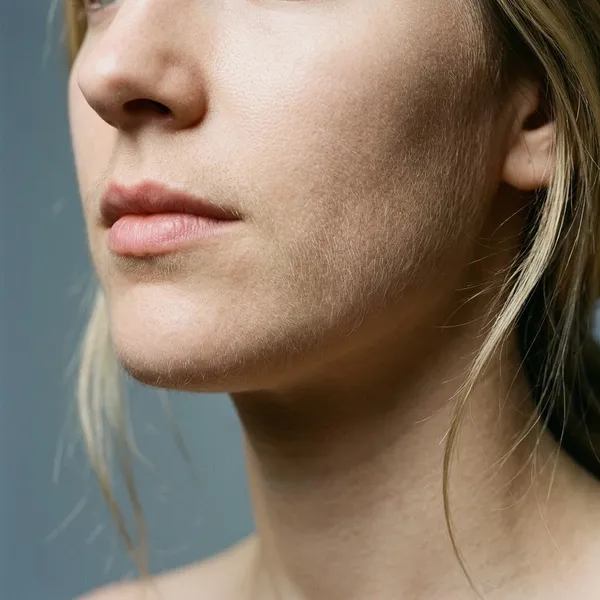
Let facial hair grow longer
Light facial hair often needs more time before it looks intentional. Very short blonde stubble blends into the skin, while slightly longer hairs overlap and create more visible shape.
For a beard or mustache, give it a few weeks before judging the density. If you are only dealing with soft upper-lip fuzz or pale sideburns, even a small amount of extra length can make the difference between "barely there" and clearly visible.
Keep the edges clean and defined
Clean edges make light hair easier to see. A tidy neckline, balanced cheek line, and neat lip border can make a blonde beard or mustache look deliberate without needing to darken every hair. Keep the shape simple; sharp, over-carved lines can look more obvious than the hair itself.
Use grooming products for more texture
Texture helps because flat, silky, pale hair reflects light and disappears. A small amount of beard balm, matte styling cream, or light wax can separate the hairs and give them more body.
- Start clean: oil and buildup can make fine blonde hair clump and look thinner.
- Use less product: too much balm can flatten the hair instead of lifting it.
- Comb outward first: build volume before shaping the hair back into place.
- Trim after styling: this helps you avoid cutting off length that was adding density.
Use temporary beard color for more contrast
Temporary beard color is useful when you want contrast for a photo, event, or a short-term style change. Tinted beard gel, beard mascara, or a wash-out color can darken pale areas without committing to permanent dye.
How to remove blonde facial hair
Removal depends on the type of hair. Fine blonde peach fuzz is usually easiest to manage with shaving or dermaplaning, while isolated coarse hairs are better handled one by one. If you want permanent removal, electrolysis is usually the method to look at first because it does not need dark pigment.
Shaving or dermaplaning for quick removal
Shaving and dermaplaning are the quickest options for blonde peach fuzz on the cheeks, upper lip, or jawline. They work regardless of hair color and do not make the hair grow back thicker, although blunt regrowth can feel more noticeable for a short time.
Use a clean blade, light pressure, and avoid irritated skin, active breakouts, or freshly exfoliated areas. This is a good low-commitment choice if the hair only bothers you under makeup or in bright light.
Threading or waxing for longer-lasting smoothness
Threading and waxing remove hair from the root, so smoothness usually lasts longer than shaving. Threading is better for precise small areas such as the upper lip or sideburn edge; waxing is faster for a larger patch but can be harsher.
Be careful with waxing if you use retinoids, exfoliating acids, acne treatments, or prescription skin creams, because the skin may lift or become more irritated. If your skin reacts easily, test a small area before doing the whole upper lip or cheek.
Tweezing for isolated coarse hairs
Tweezing is best for a few individual hairs, not a full area of peach fuzz. Use bright light, hold the skin taut, and pull in the direction of growth. Do not dig for hairs under the skin; that usually creates more redness than the hair itself.
Electrolysis for permanent removal
Electrolysis is the most dependable permanent option for blonde facial hair because it treats the follicle directly instead of relying on pigment. That makes it suitable for blonde, red, gray, and white hairs that laser may not target well.
The trade-off is time. Each follicle is treated individually, and multiple sessions are usually needed because hairs grow in cycles. It makes the most sense for people who want lasting removal on areas such as the upper lip, chin, or a small patch of persistent coarse hair.
Does laser or IPL work on blonde facial hair?
Laser and IPL usually work poorly on very light blonde facial hair because both need enough pigment in the hair to absorb light energy. If the hair is pale, fine, or almost transparent, there often is not enough melanin for meaningful reduction.
Blonde hair often has too little pigment for laser
Laser targets melanin, so dark hair usually absorbs the energy better than blonde hair. A coarse dark-blonde chin hair may respond somewhat, but fine white-blonde fuzz often will not absorb enough energy to damage the follicle.
IPL also depends on hair pigment
IPL uses broad-spectrum light, but it still depends on pigment in the hair. Home IPL devices can be especially disappointing for blonde facial hair because they are typically less powerful than professional systems and still need contrast between hair and skin.
If IPL worked on your darker leg hair but not your upper-lip fuzz, that does not mean you used it wrong. The facial hair may simply be too light and fine for the device to target well.
Very light blonde hair usually responds poorly
Very light blonde hair, white-blonde hair, and nearly transparent peach fuzz are poor candidates for laser and IPL. The weaker the color and the finer the strand, the less energy the hair can absorb.
- More likely to respond: coarse, dark-blonde hair with visible contrast against the skin.
- Less likely to respond: soft peach fuzz that only shows in sunlight.
- Better next step: ask about electrolysis before paying for repeated light-based sessions.
Electrolysis does not rely on hair color
Electrolysis works differently because it treats the follicle directly. Hair color is not the deciding factor, so it remains a realistic option when laser or IPL is unlikely to work on blonde facial hair.
Results still depend on the skill of the electrologist, consistency, and completing enough sessions. For someone who wants permanent removal of pale upper-lip hair or stubborn light chin hairs, it is usually the more sensible long-term route.
Conclusion
Blonde facial hair is usually a normal mix of genetics, pigment, lighting, and sun exposure, so the best choice depends on what bothers you most. Grow and define it if you want more visible facial hair, use shaving or dermaplaning for quick peach-fuzz removal, and consider electrolysis rather than laser if the hair is very light and you want a permanent result.
FAQS
Does the sun make facial hair lighter?
Yes. Sun exposure can fade the outer hair shaft, so the ends of a mustache or beard may look more golden than the roots.
Will blonde facial hair get darker with age?
It can, especially from puberty into early adulthood, but it is not guaranteed. Some people keep light facial hair, while others develop a mix of blonde, brown, red, or gray strands.
Can blonde facial hair be removed with laser?
Sometimes, but very light blonde hair usually responds poorly. Laser works best when the hair is dark enough to absorb the light energy.
What is the best way to remove blonde peach fuzz?
For quick at-home removal, gentle shaving or dermaplaning is usually the easiest choice. If you want permanent removal and the hair is very light, electrolysis is more reliable than laser or IPL.


Popular Articles




