How Can You Remove Blonde Facial Hair Safely?
Blonde facial hair removal is usually easier when you stop treating all facial hair the same. Laser and IPL often struggle with pale hair, so peach fuzz is usually better handled with dermaplaning or shaving, while stubborn recurring hairs are better candidates for electrolysis. The first thing to check is simple: is the hair fine and widespread, or is it coarse, recurring, and limited to a few spots?

Why are laser and IPL less effective on blonde facial hair?
Laser and IPL work best when there is enough dark pigment in the hair for the device to target. Blonde facial hair often has too little pigment, especially when it is soft peach fuzz on the cheeks, upper lip, or jawline.
Blonde hair contains less melanin
Melanin is the pigment that gives hair its color. Dark hair gives laser and IPL a clearer target; blonde hair gives them much less to work with. Fine blonde fuzz is especially difficult because it is both light and thin.
Laser needs pigment to target the follicle
Laser hair removal sends concentrated light into the hair shaft, where pigment absorbs the energy and converts it into heat. With blonde hair, there may not be enough pigment to carry that heat down to the follicle in a useful way.
A darker blonde chin hair may respond differently from pale cheek fuzz, so a patch test can be worth asking about if your hair color varies by area. For very light facial hair, though, laser often leads to weak or patchy reduction rather than a reliable result.
IPL also depends on hair pigment
IPL is not the same as laser, but it has the same basic limitation for blonde hair: it needs contrast between the hair and the skin. Home IPL devices can be especially disappointing on blonde upper lip hair or cheek fuzz because the hair does not absorb enough energy.
- Best-case use: darker blonde hair on fair skin, tested carefully first.
- Poor match: pale peach fuzz, white-blonde hair, or very fine facial hair.
- Common mistake: buying a home IPL device expecting it to work like it does on dark leg hair.
Very light blonde hair usually responds poorly
If the hair looks almost transparent in bright light, laser and IPL usually have too little pigment to target. In that situation, money is often better spent on a method that physically removes the hair, or on electrolysis if you want a permanent route.
Which temporary methods work best on blonde facial hair?
The best temporary methods are the ones that do not care what color the hair is: dermaplaning, shaving, threading, waxing, and tweezing. The real choice is not "which one works on blonde hair?" but "which one fits the area and how often am I willing to maintain it?"
For a quick weekday routine before makeup, surface methods are usually enough. For a holiday, wedding, or stretch of time when you want longer smoothness, root-removal methods may be worth the extra sting or irritation risk.
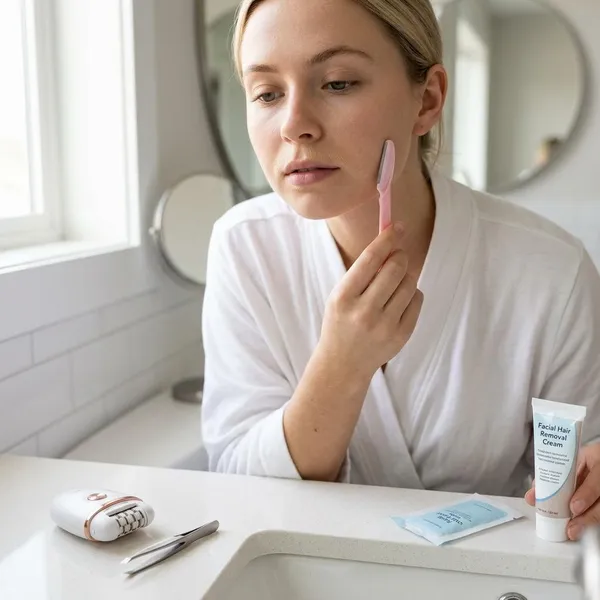
Dermaplaning for full-face peach fuzz
Dermaplaning is often the neatest option for full-face peach fuzz because it removes fine surface hair evenly. It works well on cheeks, jawline fuzz, sideburn areas, and other places where tweezing would be far too slow.
Use a clean facial blade, light pressure, and short strokes. Skip irritated skin, active acne, sunburn, or areas you have recently exfoliated heavily. If your skin reacts easily, spacing sessions out is usually smarter than chasing perfectly fuzz-free skin every few days.
Shaving for quick maintenance
Shaving is the simplest low-commitment option. It is useful when you want a fast tidy-up before work, makeup, photos, or an event, and it does not make hair grow back thicker. Regrowth can feel blunt because the hair has been cut straight across, but shaving does not change the follicle.
- Choose it for: fast upkeep and low cost.
- Avoid rushing: dull blades and too much pressure cause most irritation.
- Try first: dry shaving or a small amount of facial oil, depending on what your skin tolerates.
Threading for small facial areas
Threading is a strong choice for small, visible areas such as the upper lip or brows. It pulls hair from the root without wax, heat, or depilatory cream, which can make it appealing if your skin dislikes product-heavy methods.
Waxing for longer-lasting smoothness
Waxing removes hair from the root, so it can keep the skin smooth longer than shaving or dermaplaning. It can work well on the upper lip, chin, or sides of the face when your skin tolerates it.
Be more cautious if you use retinoids, strong exfoliating acids, acne treatments, or have recently had a peel, because waxing can increase the risk of skin lifting or irritation. A small patch test is a better first step than waxing a full visible area right before an event.
Tweezing for isolated hairs
Tweezing is best for a few isolated hairs, not for full-face fuzz. It makes sense for one or two coarse blonde chin hairs that appear between other grooming sessions.
Use clean, sharp tweezers and pull in the direction of growth so the hair is less likely to snap. If you are checking the same spot every morning, that is a sign the problem may be better suited to electrolysis than endless plucking.
Is electrolysis best for permanent blonde facial hair removal?
For permanent removal of blonde facial hair, electrolysis is usually the most reliable option because it does not depend on hair pigment. Instead of trying to target color, it treats the follicle directly.
It is not instant. You need repeated appointments, and the process can feel slow if you are treating many fine hairs. But for stubborn blonde chin hairs, recurring upper lip hairs, or light hairs that never responded to laser, electrolysis is the professional option that most directly matches the problem.
Electrolysis does not depend on hair color
Electrolysis can be used on blonde, gray, white, red, and mixed-color facial hair because the treatment is applied inside the follicle. That makes it especially useful if a clinic has already told you that laser or IPL is unlikely to work for your hair color.
It can treat fine and coarse blonde hairs
Facial hair is often mixed: soft cheek fuzz in one area, thicker chin hairs in another. Electrolysis can treat both, but the plan may differ. A few coarse recurring hairs are usually more manageable to target than a wide area of fine fuzz, simply because each follicle is treated one by one.
It targets individual hair follicles
The precision is the main advantage. If only five chin hairs bother you, the electrologist can focus on those five instead of treating the whole lower face.
This is useful for people who do not mind peach fuzz but hate the same few visible hairs returning. Starting small can also make the cost and time commitment feel more realistic.
Multiple sessions are usually needed
One session is not enough because facial hair grows in cycles. Some hairs are ready to treat, while others are not visible or active yet. Most people need a series of appointments, with spacing and total time depending on the area, density, and how consistently they go.
Which method fits your blonde facial hair?
Match the method to the hair pattern before thinking about devices or treatments. Fine and widespread usually means surface removal. Small and visible often means threading or waxing. Coarse, recurring, and annoying usually points toward tweezing for short-term control or electrolysis for a longer-term fix.
| What you notice | Best fit | Why it makes sense |
|---|---|---|
| Soft fuzz across cheeks or jawline | Dermaplaning or shaving | Fast, even surface removal |
| Upper lip hair visible in bright light | Threading or waxing | More precise and longer-lasting than shaving |
| A few coarse chin hairs | Tweezing or electrolysis | Targeted control without treating the whole face |
| Same hairs returning again and again | Electrolysis | Best match when permanent removal is the goal |
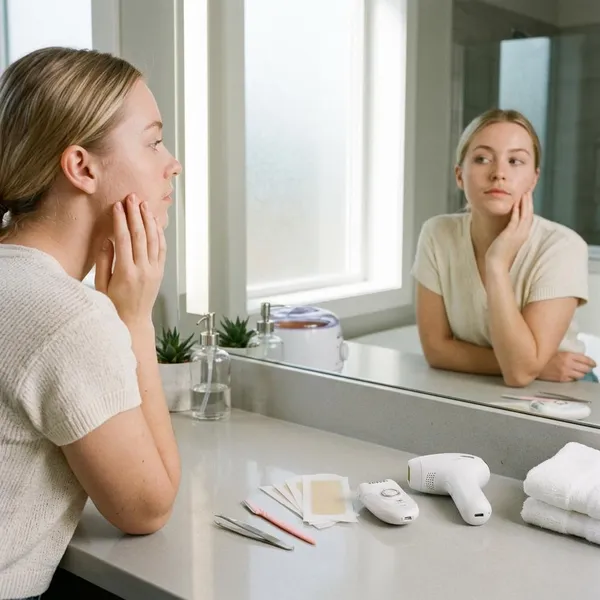
Dermaplaning for fine cheek and jawline fuzz
Choose dermaplaning when the hair is soft, light, and spread over a broad area. It is especially helpful if peach fuzz catches foundation, makes sunscreen look uneven, or shows more in side lighting than straight-on mirror light.
Threading for upper lip hair
Upper lip hair is small enough that threading can be worth the discomfort. It gives a clean result without needing to shave the area every few days, and it avoids the product sensitivity some people get with wax.
If your upper lip becomes red easily, avoid booking threading right before a photo-heavy event. Give your skin a little time to calm down first.
Tweezing for scattered chin hairs
Tweezing fits the "one hair here, one hair there" situation. Keep it limited: if you start plucking a larger patch, irritation and broken hairs become more likely.
Electrolysis for stubborn recurring hair
Electrolysis is the better choice when maintenance starts feeling constant. If the same light chin or upper lip hairs keep coming back and laser is not a good match, treating those follicles directly is usually more sensible than switching between temporary methods forever.
Conclusion
The most sensible choice depends on whether you are managing soft fuzz or fighting the same stubborn hairs over and over. Use dermaplaning or shaving for quick peach-fuzz control, threading or waxing for small areas where longer smoothness matters, and electrolysis when recurring blonde hairs are worth treating permanently. Laser and IPL are not impossible in every case, but very light facial hair usually deserves a different plan.
FAQS
Can blonde facial hair be removed with laser?
Sometimes, but very light blonde facial hair usually responds poorly. A consultation or patch test may be useful for darker blonde hairs, but pale peach fuzz is rarely an ideal laser target.
Does IPL work on blonde facial hair?
Usually not well. IPL needs pigment in the hair, so home devices and salon IPL treatments often give weak results on fine blonde facial hair.
What is the best way to remove blonde peach fuzz?
Dermaplaning is often the best fit for soft blonde peach fuzz across the cheeks or jawline. Shaving is the easier backup if you want a faster, lower-effort routine.
What permanently removes blonde facial hair?
Electrolysis is the strongest permanent option for blonde facial hair. It treats each follicle directly, so hair color is not the deciding factor, but multiple sessions are normally needed.

Popular Articles




