Which Laser Hair Removal Option Suits Facial Hair Best?
If your facial hair is dark and your skin tone is within the safe range for light-based devices, the best laser hair removal for facial hair is usually either at-home IPL for small maintenance areas or professional laser for dense, coarse growth. Start with three checks: your skin tone, your hair color, and whether the hair is mild touch-up growth or persistent hormonal growth. Light blonde, gray, white, and red hairs usually need electrolysis instead of IPL or laser.

What is the best laser hair removal for facial hair?
The best choice is the one that matches the risk level of your face, not simply the strongest device. For small dark hairs on the upper lip or chin, at-home IPL can be a practical long-term routine. For thick chin hair, a dense jawline pattern, or hair that comes back quickly after shaving, professional treatment is usually the more sensible first step.
| Facial hair situation | Better starting point | Why it makes sense |
|---|---|---|
| Small areas with dark hair, such as upper lip or a few chin hairs | At-home IPL | Convenient, private, and easier to maintain regularly |
| Coarse, fast-growing chin or jawline hair | Professional laser | Stronger treatment and better setting control |
| Darker skin tone with coarse dark facial hair | Nd:YAG in clinic | Often preferred because it is designed to reduce surface pigment risk |
| Blonde, gray, white, red, or isolated light hairs | Electrolysis | Does not depend on pigment in the hair |
Ulike Air 10 for at-home IPL
Ulike Air 10 is not a true laser; it is an IPL device. It can make sense if you want to manage dark upper-lip, chin, or jawline hair at home and you are comfortable following a repeated treatment schedule. The cooling feature is especially relevant on the face, where even a small sting can make people give up too early.
- Best fit: dark facial hair on a compatible skin tone.
- Most realistic use: gradual reduction and maintenance, not instant removal.
- Do not use the device on recently tanned or irritated skin, or if your skin tone falls outside Ulike's compatibility range. If your skin is highly reactive, check the instructions carefully and perform the recommended patch test before treatment.
Alexandrite laser for lighter skin with dark hair
Alexandrite laser is often a strong clinic option for lighter skin with dark facial hair because it targets pigment efficiently. It can be useful for upper lip, sideburn, or chin areas when there is clear contrast between skin and hair. The trade-off is that it may carry more pigmentation risk on deeper skin tones, so it should not be treated as a universal choice.
Diode laser for versatile professional treatment
Diode laser is a flexible professional option for many people with medium to coarse facial hair. It is often considered when the hair is too stubborn for home IPL but the provider still wants adjustable treatment across different facial zones.
If your situation is "I can shave in the morning and still feel chin stubble by evening," diode treatment may be worth discussing at a clinic. It does not remove the need for multiple sessions, but it can reduce trial and error compared with guessing at home.
Nd:YAG laser for darker skin tones
Nd:YAG is generally the safer professional laser direction for darker facial skin because its longer wavelength is less focused on pigment near the skin surface. That does not make it risk-free, especially on the face, but it is often the option to ask about if burns or post-treatment discoloration are a concern. A patch test and an experienced provider matter more here than a discounted package.
Best at-home devices for facial hair
At-home devices are most useful when facial hair is manageable enough that you can treat it regularly without needing clinic-level power. Think of them as a routine tool: helpful for privacy, touch-ups, and slower regrowth, but less ideal for heavy hormonal growth or hair colors that light cannot detect well.
Before choosing one, check the device's facial-use instructions, skin tone chart, and whether it has a smaller treatment window or enough control for the upper lip. The face is not the place to improvise around moles, broken skin, tattoos, or the eye area.
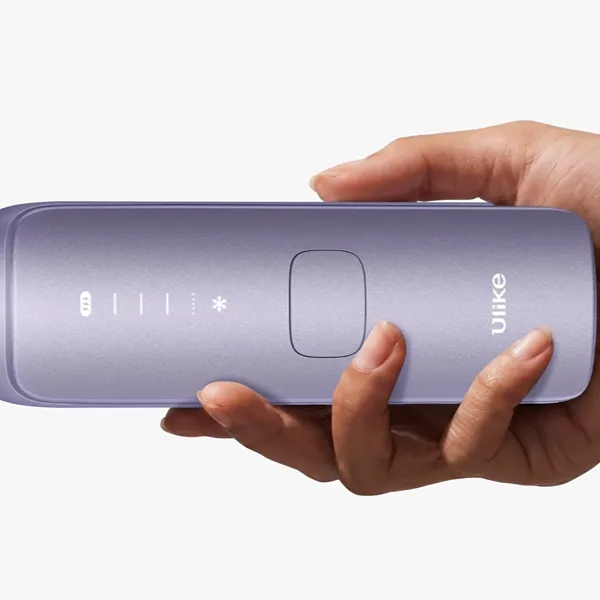
Ulike Air 10 for comfort and stubborn facial hair
Ulike Air 10 is the stronger at-home pick in this group for people who want a more comfortable IPL routine on stubborn but still suitable facial hair. It is most useful for someone who has dark chin or upper-lip hair, wants privacy, and is willing to stay consistent for weeks rather than expecting a clinic-like change after one session.
Ulike Air 4 for a simpler IPL routine
Ulike Air 4 is a more affordable, comfort-focused option for small facial areas when the hair and skin tone are compatible. It offers multiple power modes, including settings for finer hair and more stubborn growth, while maintaining Ulike's Sapphire Ice Cooling. If you only want to keep mild upper-lip regrowth under control, a straightforward device can be easier to stick with than a more advanced one you rarely use.
Braun Silk Expert Pro 5 for precision treatment
Braun Silk Expert Pro 5 is a good alternative if precision and guided intensity feel more important than choosing the highest-powered-looking option. Its appeal is practical: small areas such as the upper lip or chin need careful placement, not rushed flashes across sensitive skin.
Which option works best for different facial areas?
Facial areas behave differently. Upper-lip hair may be fine but visible, chin hair is often coarser, and jawline hair can be influenced by hormones. The useful question is not "Which device is best?" but "Which area am I treating, and how stubborn is that hair?"
- Upper lip: prioritize comfort, careful placement, and low irritation.
- Chin: look at thickness and how quickly hair returns.
- Jawline and lower cheek: consider whether the pattern is hormonal or spreading.
- Scattered light hairs: skip IPL expectations and consider electrolysis.
IPL for upper lip and chin hair
IPL can be a reasonable at-home choice for upper lip and chin hair when the hairs are dark and the skin tone is approved for the device. The upper lip is more sensitive, so start conservatively and avoid treating too close to the lips or nostrils. On the chin, coarse dark strands may respond better, but hormonal regrowth can still need ongoing maintenance.
- Shave first: light should reach the follicle, not burn hair above the skin.
- Patch test if advised: the face reacts faster than many body areas.
- Use even placement: missed spots are more obvious on the face.
- Track regrowth: slower return and softer texture are early signs of progress.
IPL for jawline and lower cheek hair
Jawline IPL is most realistic for moderate dark growth that you can maintain regularly. If the area is a few visible patches before summer photos, at-home IPL may be enough. If it is year-round, dense, and spreading along the lower face, it is worth asking a clinic whether laser would be more efficient.
Lower cheek hair is trickier when it is soft or downy. Treating fine facial fuzz with IPL is often disappointing, and aggressive treatment in the wrong situation can irritate skin without giving much reduction.
Professional laser for dense coarse facial hair
Professional laser is usually the better choice when facial hair is dense, coarse, or fast-growing. This is especially true for chin and jawline hair that feels hard to manage with shaving, tweezing, or occasional IPL. A clinic can choose Alexandrite, diode, or Nd:YAG based on your skin tone and hair type instead of forcing one device to fit every case.
Electrolysis for isolated light-colored hairs
Electrolysis is the better match for isolated blonde, gray, white, or red facial hairs because it treats follicles individually and does not rely on melanin. It can also be useful after laser or IPL has reduced the darker hairs and only a few pale stubborn hairs remain.
Conclusion
Choose by skin tone, hair color, and hair density before choosing by brand. Ulike Air 10, Ulike Air 4, and Braun Silk Expert Pro 5 are most useful for compatible dark facial hair that you want to manage privately at home, while Alexandrite, diode, and Nd:YAG make more sense when the hair is coarse, dense, or higher-risk to treat. If the hair is light-colored or only a few strands are left, electrolysis is often the cleaner decision.
FAQS
What type of laser is most effective for facial hair removal?
For lighter skin with dark hair, Alexandrite is often very effective; for a wider range of cases, diode is commonly used. The most effective option still depends on contrast, hair thickness, and whether the provider can treat your face safely.
Is Ulike Air 10 a laser or IPL device?
Ulike Air 10 is an IPL device, not a laser. It uses broad-spectrum light for gradual hair reduction, so consistency and skin-hair compatibility matter more than expecting instant clearance.
Which laser is safest for darker facial skin?
Nd:YAG is generally the safer laser type to ask about for darker facial skin. A patch test and an experienced operator are still important because facial pigmentation changes can be difficult to hide while healing.

Popular Articles




