Can the Conture Device Remove Facial Hair?
If you searched for contour facial hair removal, you are probably trying to work out whether the Conture facial remover is a quick fix or a real long-term hair removal method. Treat it as a small surface shaver with a separate polishing attachment: useful for fast touch-ups on dry skin, but not something that removes hair from the root or slows regrowth.

What do the Conture attachments do?
The Conture attachments have two separate jobs. The shaving head trims visible facial hair close to the skin, while the polishing head lightly buffs the surface of the skin. The most important point is not to expect both heads to do the same thing: one is for hair, the other is for texture.
If you only want a quick upper-lip or chin touch-up before work, the shaving head is the part that matters. If your makeup catches on dry patches, the polishing head may help, but it should be used more sparingly.
Rotary blades shave facial hair
The rotary shaving head cuts hair at the surface instead of pulling it from the follicle. That usually makes it more comfortable than waxing, threading, or tweezing, especially for fine facial fuzz on the cheeks, upper lip, jawline, and chin.
Use it when the hair is already noticeable but you do not want to wait for enough regrowth to wax. Coarse chin hairs may still need slower passes or more frequent touch-ups, but pressing harder is the mistake to avoid; it is more likely to irritate the skin than improve the shave.
The polishing head exfoliates skin
The polishing head is for light exfoliation, not deep resurfacing. It can help lift loose flakes and surface buildup, which is useful if foundation tends to cling around the chin, cheeks, or upper lip.
- Good use: occasional smoothing before makeup or when skin feels slightly rough.
- Be careful: sensitive, peeling, sunburned, or freshly treated skin can react badly.
- Avoid overuse: if skin feels tight, warm, or red afterward, use it less often.

What results can you expect from Conture?
Expect a cleaner, smoother look right away, but keep expectations realistic. Conture works like a compact facial shaver, so the result is cosmetic and temporary rather than long-lasting hair reduction.
The best results are usually on fine or medium facial hair. If you have darker, thicker hairs on the chin or upper lip, the device can still help with maintenance, but regrowth may be easier to feel and see.
| Situation | What to expect | Best approach |
|---|---|---|
| Fine peach fuzz | Quick visible smoothing | Light circular passes |
| Coarse chin hair | Surface trimming, faster regrowth | Slow touch-ups without pressure |
| Reactive skin | Higher redness risk | Patch test and skip polishing if unsure |
Immediate surface hair removal
The clearest benefit is speed. Once the shaving head passes over the area, visible hair is cut down near the skin line, so the face can look smoother without waiting for redness to settle the way some people do after waxing.
This makes the device most useful for low-risk, last-minute situations: a quick tidy before applying makeup, photos, a video call, or leaving the house. It is not the right tool if your goal is to stop hair growth at the root.
Temporary smoothness
The smooth feeling comes from surface hair removal and, when used carefully, mild polishing. How long it lasts depends on your own growth pattern; fine hair may stay less noticeable for several days, while coarse hair can feel rough again sooner.
Regrowth that needs touch-ups
Regrowth is part of using Conture because the follicle is untouched. For occasional users, that may mean reaching for it only before events. For someone managing visible chin or upper-lip hair year-round, it is better to think of it as a repeat maintenance tool rather than a one-time treatment.
How to use the Conture hair remover
Start with the basics: clean skin, dry skin, the correct head, and a light hand. Those four checks matter more than going over the same area again and again.
- Cleanse and dry your face fully.
- Attach the shaving head securely.
- Turn the device on and use small circular motions.
- Stay away from the eyes, lash line, and inner lip.
- Switch it off before checking the skin or removing the head.
Clean and dry your skin
Use the device on skin that is free from makeup, sunscreen, heavy moisturizer, and oil. Dry hair is easier for the shaving head to catch, and clean skin also keeps less residue from collecting inside the attachment.
If washing leaves your face flushed, wait a few minutes before starting. That small pause is especially useful for people who redden easily around the upper lip or cheeks.
Check and secure the shaving head
A loose head can wobble, miss hairs, or make you repeat passes on the same patch. Before switching on the device, check that the shaving attachment is seated firmly and aligned properly.
Glide gently in small circles
Small circles help the rotary blade catch hairs that grow in different directions. This is helpful on the chin and upper lip, where straight strokes often miss short or angled hairs.
- Use light contact, not pressure.
- Move slowly enough for the blade to catch the hair.
- Stop if the skin stings, heats up, or turns noticeably red.
Avoid the eye and lip areas
Keep the device on outer facial skin only. Do not use it near the lash line, under the eye, or on the soft inner lip area, because those spots are more delicate and easier to irritate.
For upper-lip hair, stay on the skin above the lip rather than dragging the head across the lip edge. Leaving a tiny untreated border is safer than trying to shave too close.
Switch off after use
Turn the device off before inspecting your skin, changing heads, or cleaning it. This protects the motor, saves battery life, and prevents accidental contact while you handle the attachment.
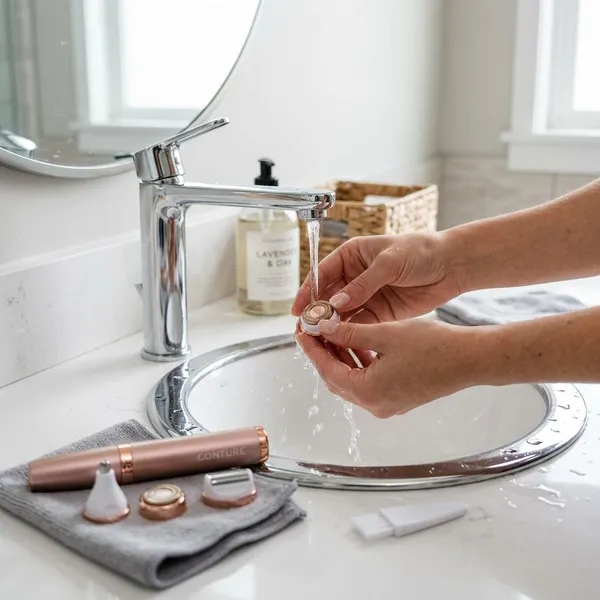
How to clean the Conture attachments
Cleaning matters because tiny facial hairs, skin flakes, and product residue can build up faster than expected. A clogged head may feel less smooth, miss more hairs, or make you press harder without realizing it.
Keep the routine simple: open what your model allows, empty loose hair, brush away buildup, and let the parts dry before storing. Avoid washing the motorized body unless the product instructions clearly say it is safe.
Remove the batteries and heads
If your model has removable batteries and detachable heads, take them out before cleaning. This lowers the chance of accidental activation and gives you better access to the areas where hair collects.
Empty the hair reservoir
Open the collection area if the device has one and tip the loose hair into a bin. Do this soon after use, before fine hairs and skin residue become packed into the corners.
Brush away hair and buildup
Use the small cleaning brush, or another soft dry brush, to clear hair from the openings and edges of the head. Avoid pins, tweezers, or scraping tools because they can damage small parts.
If residue looks sticky, check the product instructions before adding water or cleanser. Some removable heads may tolerate limited cleaning, but the main device should be treated more carefully.
Let the heads dry fully
Let cleaned heads air dry completely on a clean towel before reattaching or storing them. Trapped moisture can make the tool smell stale and may leave the attachments feeling less hygienic the next time you use them.
Conclusion
Conture is a sensible choice if you want quick, low-pain facial grooming and you are comfortable with regular touch-ups. Use the shaving head for visible hair, save the polishing head for occasional texture smoothing, and skip both when skin is irritated; that realistic approach will give you a better experience than expecting permanent hair removal from a surface shaver.
FAQS
Does Conture make hair grow back thicker?
No. It cuts hair at the surface, so the tip can feel blunt as it grows back, but the device does not change the follicle or create thicker hair.
Can Conture remove coarse chin hair?
Yes, but only at the surface. Coarse chin hair may need slower passes and more frequent upkeep, and very dense growth may last longer with root-removal or professional options.
How often should you use the polishing head?
For many people, once a week is a cautious starting point. Use it less often if your skin feels dry, tight, or sensitive afterward.
Can you use Conture on irritated skin?
No. Wait if the area is red, broken, peeling, sunburned, or recently treated with strong exfoliating products, then restart gently only when the skin feels calm.



Popular Articles